If you have never used a trading bot, it can look like a black box. Money goes in, trades come out, and you are meant to trust what happens in between.
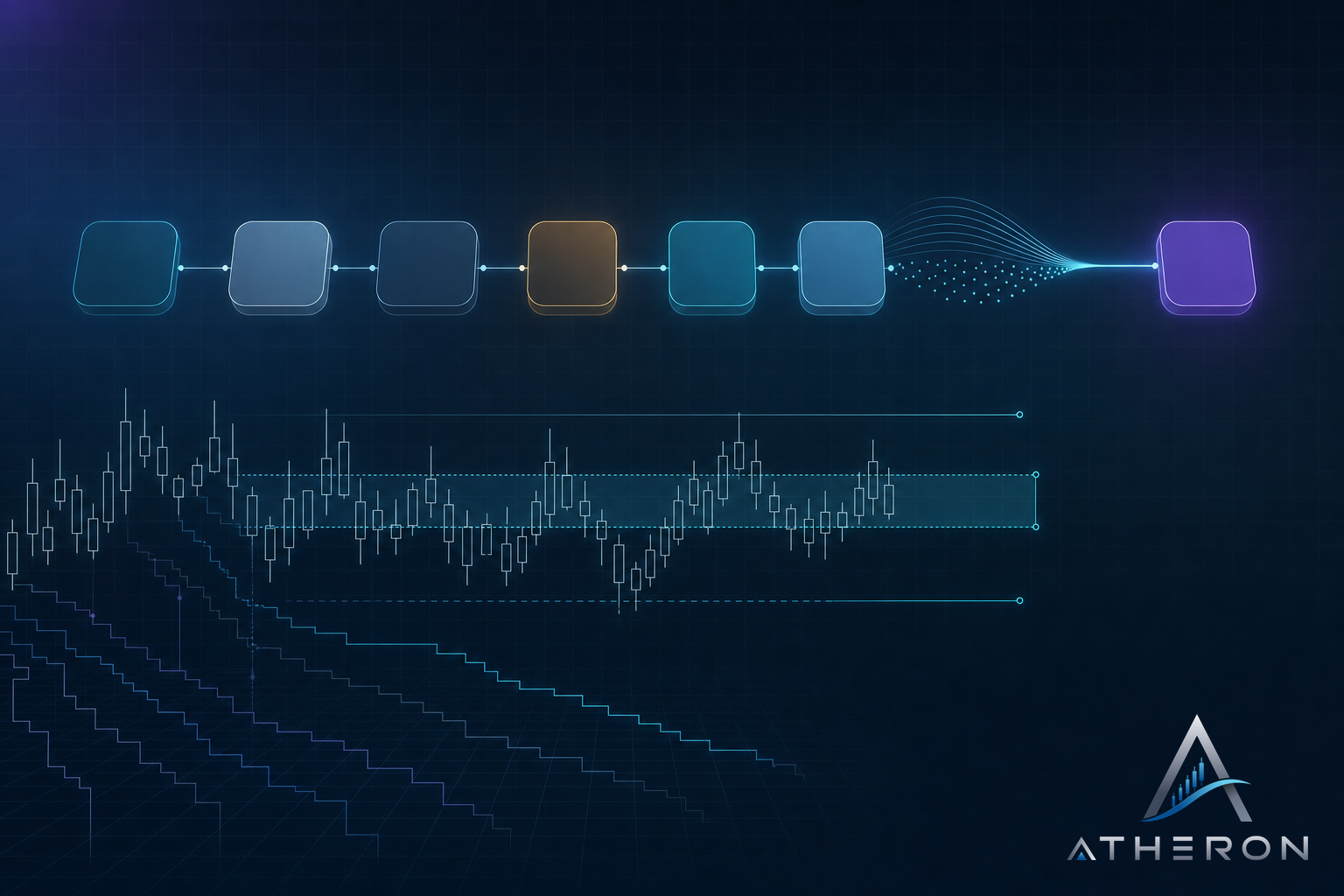
We built Atheron Trading so that the middle is not hidden. It is a short chain of steps, and you can see and set most of them. Here is each piece, in the order it works.
The parts on the table
Before anything moves, there are four things involved:
- Your exchange account. Your money lives here, in your name. Atheron never holds it.
- An API key. A permission you create at your exchange that lets the bot place trades for you.
- ATON Kestrel. Our own AI model, which runs the bot.
- Your rules. Your budget, your stop-loss and the list of coins you allow.
Everything below is how those four fit together.
Step 1: You connect with a key that can trade, never withdraw
The bot reaches your exchange account through an API key. That key can place trades. It cannot withdraw. So the bot can buy and sell inside your account, but it has no way to move money out of it.
This is what non-custodial means in practice. Your funds stay at your exchange, under your login, the whole time.
Step 2: You set the rules first
You decide the limits before the bot does anything. How much it may use, where a stop-loss sits, and which coins it may trade. These rules are not suggestions to the AI. They are checks that every trade has to pass.
Step 3: Two AIs read the market separately
ATON Kestrel looks at the market in two different ways, with two AIs:
- One reads charts. It looks at price and volume.
- The other reads news and social posts. It looks at sentiment, meaning the general mood around an asset.
They work on different information. A chart can look one way while the news points another.
Step 4: No agreement, no trade
A trade only goes ahead when both AIs agree. If the chart reading says one thing and the sentiment reading says another, nothing happens. Doing nothing is a normal outcome, and often the right one.
Step 5: Your rules are checked, every time
When the two AIs agree, the trade still has to pass your rules. Is the asset on your list? Does it fit your budget? Is a stop-loss in place as you set it? If any answer is no, the trade does not go through. This check happens before every single trade, not once at setup.
Step 6: The order goes to your exchange
Only then does the bot send the order, through your API key, to your own exchange account. The trade happens there, at your exchange, like any trade you would place yourself.
Step 7: You get the reason
Every trade is explained. You can see why it was made, so you are not left guessing what the bot was thinking. If a trade does not make sense to you, the explanation is where you start, and your rules are where you change things.
| Part of the process | Who handles it |
|---|---|
| Holding your money | Your exchange account |
| Creating the API key | You, at your exchange |
| Setting budget, stop-loss, coin list | You |
| Reading charts and sentiment | ATON Kestrel |
| Checking rules before each trade | Atheron Trading |
| Explaining each trade | Atheron Trading |
Where it starts: pretend money at real prices
Until launch, the bot trades with paper money only. Paper trading uses real market prices but pretend money, so you can watch the whole chain above run without risking anything. It is a good way to see whether your rules behave the way you expected.
What automation does not change
A bot follows steps. It does not remove risk. Crypto trading carries real risk, and you can lose money. Two AIs agreeing is not a promise that a trade will work out, and we make no promise of returns. Your stop-loss and budget limit what you put on the line, which is why you set them first.
The honest way to think about automated trading is this: it carries out a process you can inspect, inside limits you choose, in an account you own. If you understand each step above, you understand what the bot is doing.