If you have never used a trading bot, the idea can feel opaque. Something trades for you, somewhere, using rules you cannot see. This guide removes that fog. We follow the path one step at a time, from the key you create to the explanation you read afterwards, using Atheron Trading as the example.
Step 1: Your money stays in your exchange account
You already hold, or will open, an account at a crypto exchange. That is where your funds live, and that is where they stay.
Atheron Trading is non-custodial. We never hold your money. The bot does not move your funds into an account of ours. It works inside the account you already control.
Step 2: You create an API key that can trade but never withdraw
An API key is a kind of permission slip. You create it in your exchange account and give it to the bot. It lets the bot place orders for you without knowing your password.
Most exchanges let you choose what a key is allowed to do. For Atheron Trading, the key can trade but never withdraw. In plain terms, the bot can buy and sell inside your account. It cannot send your money anywhere else.
Step 3: You set your rules
Before any trade happens, you tell the bot your limits. There are three core rules:
- Budget: how much of your account the bot may use.
- Stop-loss: the point at which a losing position is closed, so a loss does not keep growing.
- Coin list: which coins the bot is allowed to trade. Anything not on your list is off limits.
These rules are yours, and you can keep them as tight as you like.
Step 4: Two AIs look at the market separately
Atheron Trading runs on ATON Kestrel, our own AI model. Two separate AIs do the reading, and they look at different things.
- One reads charts. It looks at price and volume, the record of what the market has actually been doing.
- The other reads news and social posts. It looks at sentiment, the mood around a asset and what people are saying about it.
Each forms its own view. Neither one can trade alone.
Step 5: Both must agree
A trade only goes ahead when both AIs agree. If the charts point one way and the news points another, nothing happens.
This is a deliberate filter. A chart signal with bad news behind it, or excited chatter with no support in price and volume, does not get through. The result is fewer trades, not more.
Step 6: Your rules are checked before every trade
Agreement between the two AIs is not the last word. Before any order goes out, the bot checks it against your rules. Is the asset on your list? Does the trade fit your budget? Is a stop-loss in place?
If the answer to any of these is no, the trade does not happen. Your rules sit above the AI's judgement, every time.
Step 7: The order is placed in your account
When everything passes, the bot uses your API key to place the order at your exchange. The trade appears in your own account history, the same way it would if you had placed it by hand.
Step 8: You read why it happened
Every trade is explained. You can see what the chart AI saw, what the sentiment AI saw, and how the trade fitted your rules.
This matters most when you are new. You are not asked to trust a black box. You can read the reasoning, decide whether it makes sense to you, and change your rules if it does not.
Where paper trading fits
You do not have to start with real money. Paper trading runs the same steps with pretend money at real market prices. You see the decisions, the rule checks and the explanations without putting funds at risk.
Until launch, the bot trades with paper money only. That gives you time to watch how it behaves before anything real is involved.
The honest limits
A careful process is not a guarantee. Here is what the steps above do not do:
- They do not promise profit. Two AIs agreeing can still be wrong.
- They do not remove market risk. Prices can move fast, and a stop-loss limits a loss rather than preventing one.
- They do not replace your judgement. You set the rules, so it pays to set them with care.
The whole path in one view
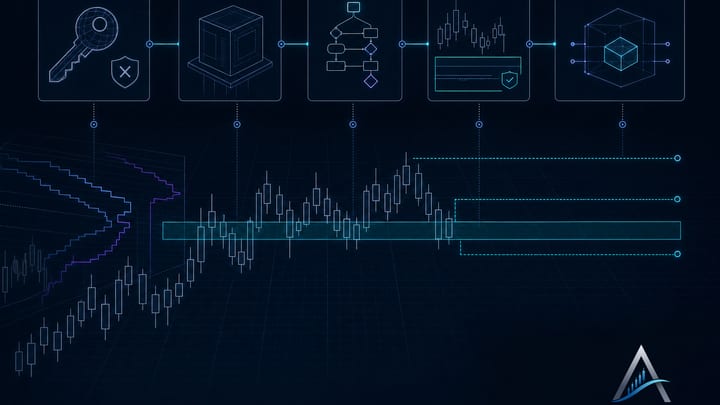
Your money stays in your exchange account. A key lets the bot trade but never withdraw. You set the budget, stop-loss and coin list. Two AIs read charts and sentiment, and both must agree. Your rules are checked. The order is placed in your account. Then you read why.
That is automated crypto trading, step by step. Nothing hidden, and each step is one you can check yourself.